
Georgia Democrats are preparing to revive a set of long-stalled measures concerning Stone Mountain, according to reporting by The Atlanta Journal-Constitution — a move that would return one of metro Atlanta's most contested landmarks to the agenda at the state Capitol.
The specific bills Democratic lawmakers intend to reintroduce, and the timetable for filing them, were not detailed in the initial report. What is clear is the framing: these are proposals that have already been introduced and have already failed to advance, and their sponsors are preparing to try again rather than start from scratch. AtlantaStar will update this story as the legislation is filed and as individual sponsors are identified.
For Atlanta readers, the stakes are local before they are symbolic. Stone Mountain Park sits in DeKalb County, roughly 16 miles east of downtown, inside a county whose population is majority Black and whose residents make up a substantial share of the park's visitors. It is one of the largest public recreation spaces in the metro area — trails, a lake, a campground, a walk-up summit path used year-round by Atlantans who have no particular interest in the politics attached to the place.
It is also state property. The park is owned by Georgia and managed by the Stone Mountain Memorial Association, a state authority whose members are appointed rather than elected locally. That structure is the reason these fights land in the General Assembly instead of at the DeKalb County Commission or inside the small city of Stone Mountain that borders the park. Decisions about what the site honors, how it is interpreted for visitors, and how its revenue is handled run through the legislature and through appointees, not through the communities closest to the gates.
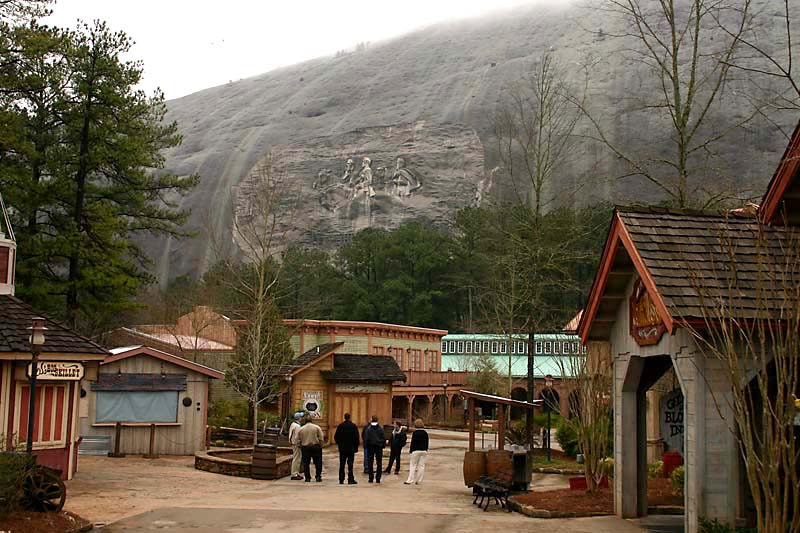
The mountain's north face carries the largest Confederate carving in the country, a relief depicting Jefferson Davis, Robert E. Lee and Thomas "Stonewall" Jackson. The site's modern history is inseparable from that image: Stone Mountain was where the Ku Klux Klan staged its 1915 revival, and the carving was completed decades later, during the era of organized resistance to desegregation. Georgia law has long shielded monuments on public land from removal or alteration, which has sharply limited what any single bill or board vote can accomplish at the park.
That legal backstop helps explain why previous Democratic efforts went nowhere. Proposals touching Stone Mountain have generally run up against two obstacles at once — a Republican legislative majority uninterested in bringing them to a vote, and a statutory framework that constrains even sympathetic administrators. Bills in recent sessions have died in committee without floor debate, which is the ordinary fate of minority-party legislation under the Gold Dome.
What has changed is the calendar. Lawmakers return to Atlanta in January for the next legislative session, and reintroducing a stalled measure early is a standard way to claim an issue and force colleagues to take a position on it, even when passage is unlikely. Filing a bill costs little; refusing to hear it is a record that can be cited later.
Progressive advocates in DeKalb and across the metro area have pressed for years for changes at the park — fuller historical interpretation of the carving and the Klan's role at the site, broader representation on the governing authority, and clearer accounting of how park revenue is spent and who benefits from its concessions and leases. Whether the revived measures address any of those priorities will depend on the text, which has not yet been made public.
AtlantaStar is tracking the filings and will report the bill numbers, sponsors and committee assignments as they become available.
Originally reported by Google News — Georgia Politics.